Category Archives: Code

Stay Warm, Stay Hydrated.

This, to the best of my knowledge, is Universal Good Advice.

Here is another piece of Universal Good Advice (UGA) from yrs truly: don’t listen too much to other people’s advice. Instead, figure things out for yourself.

To some, this directive may be threatening — in particular to lawyers and to a certain class of therapists. Historically, hackers and lawyers have a relationship that is at best glancing and at worst adversarial. Based on what do I make this generalization? Life experience.

What does it actually mean to be a hacker? Check pdxlocal.net for a few thoughts relevant to that topic. They’re in there. Along with about a million other topics relevant to me personally, and fitting what I saw as the dominant Portland ethos ’round about the last time that I lived there.

Which was some time ago. Depending how you measure time.

I helped my parents sell my apartment — a sweet condo in the fashionable but still, shall we say “edgy” neighborhood known as St. John’s — in June 2023. Anyway, that was when the deal closed. But I’ve been back to the city a fair amount since. Rented an Airbnb for a month there in May of 2024, trying to make up my mind whether to return there permanently. Finding a place to live would not have been a problem but I passed at that time, for several reasons.

The two most significant:

Severe Repetitive Strain Injury (RSI) made me feel antsy about my chances of completing the Computer Science Postbac program that would have prepared me to get a Master’s in CS. True confession: I was an English major and only took one programming course before graduating. I need an advanced degree in order to be able to teach, even at the high school level. And also because, well, you don’t know what you don’t know until it comes up and bites you in the You Know Where.

I am a rape survivor. To the best of my knowledge, the man who raped me still lives in Portland. More about that another time. Seriously, it can wait.

Anyway, what I wanted to talk about was what to do if you have a respiratory infection that just won’t go away. Such as COVID. Or RSV. Or whatever it is I’ve had, off and on, since the Spring of 2023.

I am still not sure but staying warm does seem to help. And we all know about drinking fluids.

Found out recently I had COVID. This was surprising to me because it seems like I’ve been tested for everything under the sun, in inpatient settings and out of them.

Was denied Paxlovid, because of a complication with another medication that I’m taking. Actually had a scheduled doctor’s appointment last Tuesday at my local primary care office to talk about my problems breathing, but he cancelled it after I showed up early in the waiting room  and told the receptionist I had COVID. I didn’t mind. There were also children in that waiting room. The advice on my electronic chart when I returned home was all too familiar. You guessed it: rest and stay hydrated.

Am still a bit concerned, especially since I’m still running a fever — more than a week after the test came back positive from the Urgent Care Center.

I may be immunocompromised due to the loss of a uterus in September 2022 (if you don’t know what fibroids are, look it up or read my account from earlier that same year). Or maybe for some other reason. I am 49 years old. I get tested regularly for STI’s/STD’s.

About those test results…

I had a strange experience last February. I was wearing an olive green monokini and sunning myself in a deck chair. The guy in the chair next to me looked me up and down and asked if I’d had breast cancer? I said no. I volunteered that I was HIV-negative. He seemed elated by this news. He volunteered that he was of Kurdish descent, and now lived in Philadelphia. He told me he worked in the building trades. I noticed he was wearing a rather unusual baseball cap — one that I have seen elsewhere. It was a flag similar to the Stars and Stripes, but grayed out. I asked if he could find me a safe house in Philadelphia. He said no, but offered to get me some of the free punch that was being served by the pool and then invited me to dinner.

All of this transpired in Miami Beach, Florida. Why I was there and not sheltering at home in the gloomy, mist-ridden Oregon Coast? Business, actually. Ironically enough, a healthcare startup. Had a cofounder in South Florida.

I did ask for a doctor’s advice — different doctor than the one at the family practice — about whether I was safe to fly, but never heard back from him. Had to leave a message at the reception desk. No idea if he even got it. I reasoned that heading some place warm and lying out in the sun was what any doctor would have done, so I made my way to the airport and never looked back.

A fateful decision, and probably not the right one.

AI. What Is It Good For?

June 27, 2024

Got a free pass at the last moment to the AI Engineer World’s Fair in San Francisco, found a cheap flight and a cheaper Airbnb. So here I am. Snagged a spot on one of the couches in the Expo Hall… am waiting for the crowd to thin out before I head to the buffet line for dinner.

The fact that they made scholarships to the event available based on need convinced me it would be worthwhile to drop everything and go. But this is still very much an industry event. I’ve had the vendor conversations that I need to have. (And was gifted a pair of branded free smartwool socks!)

The nice thing about deciding to go on such short notice is that I’m not here to pitch. More just to observe and listen.

Does anyone really want or need a robot barista? Microsoft appears to think so.

What I am mostly observing is a bad case of tunnel vision. People outside Wall Street and the AI industry itself don’t really understand how much negativity and mistrust exists around these technologies. Activists tend to call for regulation — and while this is needed, it will also put these tools out of reach for independent developers and small startups like my own.

But it hasn’t happened yet.

I am tempted to just put my head down and use Claude Sonnet to build as much high-quality algorithmic generated code as I can, while the getting is good. In all likelihood, that is exactly what I will be doing for the rest of the summer. But I would also like to outline a few ways in which AI can be used to solve problems that are otherwise intractable.

I have identified six:

Accessibility, Community Moderation, Content Curation, Consensus Building, Education, and Employment

(A3C2E, if you need a really clunky and difficult to remember acronym.)

  • Accessibility. Voice recognition is almost to the point of being usable in place of keyboard and mouse, but not quite. As somebody who lives daily with constant physical pain from repetitive strain injury, the evolution of this technology to allow hands-free coding and web browsing on a range of devices would be night-and-day. It isn’t there yet. But it certainly could be.
  • Community Moderation, Content Curation, and Consensus Building. We don’t need more generated artwork, writing, and music. We are drowning in high-quality information already. What we need are ways to make sense of the incredible richness of artistic output already available online, and connect creators with patrons and enthusiasts. Ditto for online communities of all types, and for any type of process that seeks to identify shared opinions and experiences — rather than upvoting the most extreme and polarizing opinions (something that social media algorithms appear to have encouraged, even before the advent of AI). Full disclosure: consensus building through textual analysis is what my recent work centers on.
  • Employment and Education. We need AI that creates jobs, and not just for the most highly skilled echelon of engineers. LLM’s are at a really interesting phase in their evolution right now. The best of them are at a level where they can mimic the output of an actual human. That is to say, they can respond in real time to questions and unique inputs, and generating meaningful replies. But they make mistakes. Organizations have a choice: build oversight and review into their AI workflows, or relegate AI’s to low value interactions — users who are a captive audience, or can’t afford personalized support — and leave them to deal with the consequences. But it doesn’t have to be this way.

Could job descriptions emerge along the lines of “AI Supervisor?” Would it be possible to build marketplaces and add-ons that specialize in matching human editors and graphic artists to put the finishing touches on generated AI content that is “almost but not quite” good enough? Yes, and yes. This is a different set of priorities than the current shibboleth of “AGI / Nobel Prize Level Intelligence” but it could be applied in practice with genuine and immediate results.

As remote learning becomes more commonplace, the most valuable role of AI may not be as a search engine that provides results in complete sentences. Rather than an “encyclopedia-on-demand,” correctly trained and tuned models could function as a source of input, guidance, and feedback for students working independently, particularly adult learners and those re-skilling. Yes, in an ideal world most of us would like a human tutor or mentor to work with us, but for people who cannot afford to take time off or take out many thousands of dollars in loans to pursue job training, one-on-one AI training could become a valuable counterpart to video lectures and online multiple-choice quizzes.


The challenge is that none of the categories above are easily monetizable. We are talking about meeting needs that are currently going unmet — rather than using AI to slash costs (in other words, eliminate jobs).

Given the timetable and realities of grant-based funding, charities and the public sector are extremely unlikely to lead this charge.

So what is to be done? I would advocate that it’s time for the industry itself to step up and invest in social impact projects.

This is not an exhaustive list. Other people may be able to dream up further use cases that are equally valid. But it will take more than a hack-a-thon or a single afternoon to generate meaningful results. As a coder who hails from a UX background, I am a firm advocate of user research.

Don’t build vanity projects. Instead, find partners and stakeholders.

Without visible evidence that AI is contributing something positive to our world, public retribution will be swift and absolute. Regulation won’t end inequity or violations of privacy from AI, although it may curtail the worst abuses. It will lead to something more like a guild economy, and render another sector of software (like cryptocurrency and healthcare before them) off-limits to those without professional degrees and licensure, as well as a budget that includes full-time legal counsel on staff.

In the United States, we still have a window of time to build things that are meaningful and cool.

I don’t know how long it will last. Maybe six months? Maybe one year?

I took two days off to take the pulse of the AI industry, and see what I could learn firsthand. Now it’s time to get back to work.

Why We Need Blockchain and Open Source Technology to Guarantee Fair Elections

Let’s face it.

The American people have lost faith in the electoral process. Whether you’re on the right wing and a die-hard Trumper who truly believed that evil liberals conspired to steal the 2020 presidential election, or whether you’re a mainstream progressive and concerned about the fact that in the United States, candidates who win a majority of votes (like Hillary Clinton in 2016) actually cannot become President due to the weirdness of the Electoral College, you know that something is wrong in this country. There is also the huge problem that ballots can get lost in the mail, and that not everybody has time to get to the voting booths or wants to come out and vote in the age of COVID.

What if we just had an app, or a website, for voting? Wouldn’t that make things easier?

It absolutely would. Turnout would go through the roof. Open source election technology is already mainstream, as this PDF from the respected Open Invention Network (OIN) clearly shows. Existing voting machine technologies could certainly be adapted for remote use.

But then the risk of fraud becomes higher.

How could we keep our elections secure, yet enable everyone with a cell phone or a computer to participate?

The answer is another open source technology: blockchain.

The basic premise resides in the reason why blockchain (the technology behind Bitcoin) works: it is analogous to BCC. You encrypt or do not store the identity of a person making transactions on a blockchain network, but you make many copies of the record of this transaction, so that it can be verified by independent third parties (and 4th parties, 5th parties, etc.)

My proposal is that we use the same blockchain technology to prevent fraud in US elections, and of course also elections anywhere else in the world.

#opensource could lead the way.


Creative Commons License
This work is licensed under a Creative Commons Attribution-NoDerivatives 4.0 International License.

Deepfakes

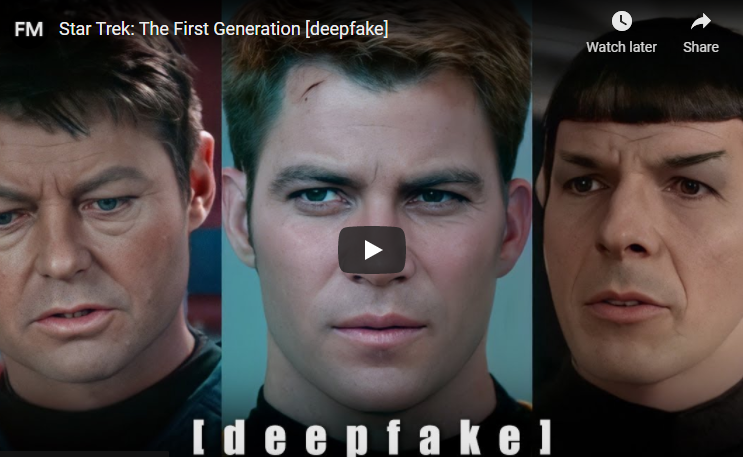
These can be benign, like re-creating a classic Star Trek episode.Star Trek Deepfake

They can also be used to assassinate someone’s character and reputation. They make it incredibly simple to create pornographic images and video about someone, based only on photos of their face.

Here is a story about to how to detect them in real life:

https://www.theguardian.com/technology/2020/jan/13/what-are-deepfakes-and-how-can-you-spot-them