I do intend to get to a meeting eventually. But there isn’t one in the town where I live. Closest one may be Missoula.
About 2600
Leave a reply

I do intend to get to a meeting eventually. But there isn’t one in the town where I live. Closest one may be Missoula.
September 24, 2026
I started it on Friday, September 18. Made the final edits day before yesterday. And I’ll be taking it down again tomorrow. This is for safety, and my own protection.
I have to go back to Cheshire. It’s where my parents live, and they are getting old enough that they need a lot of care. My husband Alex, by the way, likes his in-laws, and they dote on him. I know he will permit me at least a few short visits with them, even though it means traveling across the country. And that a lot less of the cooking and cleaning will get done at our house in Idaho!
Two notes about what I shared in the previous post:
1. The tone may surprise some people. What I was trying to get at is that racial intimidation and the ideology and enforcement of white racist regimes doesn’t just involve men with guns and torches. It also involves some “dear old ladies.” Even stay-at-home mothers. This is because, in general, the job of a #tradwife, or “traditional wife,” is to provide support. And not to question her husband’s decisions. The conservative Christian church has named this doctrine “headship.”
2. When I finished the first complete draft of the post, I was sitting at a bar and wearing black jeans. I tried to invoke this information in a symbolic way. I first learned about the existence of Prison Blues in the mid-90’s, transcribing a recorded interview while working part-time at Tripod. It is chilling and frightening that they are still around today. And headquartered in Pendleton, Oregon. Please be aware, though, that I do own denim of more than one color. If you see me, or someone else who appears to resemble me, wearing blue denim pants, don’t get upset. Don’t get too excited, either.
Fashion is a terrible signifier. The existence of exploitation in that industry is undeniable and global. However, in most climates we do need clothes to cover our bodies and us warm. A lot of shit went missing from my apartment while I was living in Lincoln City, Oregon. Including things like pajamas, microfiber fleeces, and heavy wool sweaters. I have some clue as to who the culprits may have been. Not all of them spoke English.
I have also had underwear stolen from hotel rooms. Right here in Portland, Oregon.
So let me repeat, once more:
I do own blue jeans. I occasionally wear them. This does not AT ALL mean that I am in favor of white racism or white supremacy, or indeed any group’s racism or ambitions for supremacy.
These are my blue jeans. Not your blue jeans. Don’t borrow or steal them.
Blake Thomas, my ex-husband and college sweetheart, introduced me to the song above. That was long before we moved to North Carolina. While I am a Christian, I am not a Creationist. I believe in the theory of evolution. Much more importantly, I believe in God.
Congratulations. Right now it has been approximately 76 minutes since your last cigarette.
The time before, you lasted four days.
Trust me, quitting smoking is not easy. But it can be done.
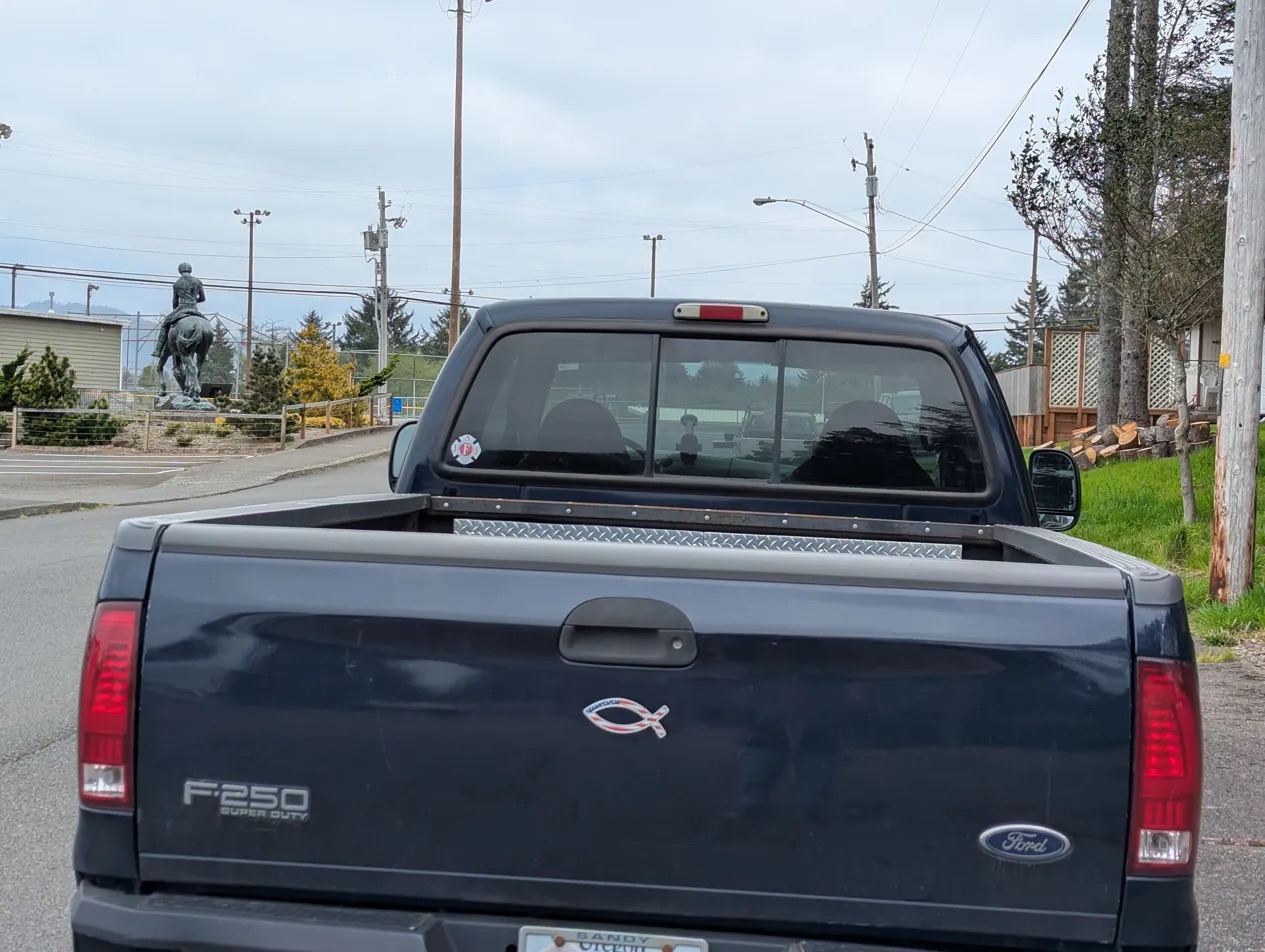
I saw the symbol on a navy blue pickup truck, parked on the street where I live. I’m in the process of moving out. That’s why I was out and about on that particular Sunday morning. There’s a church nearby that I’ve never set foot in. I had a bad experience at a different church in this town. Although, to be totally fair, I went to several others that seemed perfectly fine.
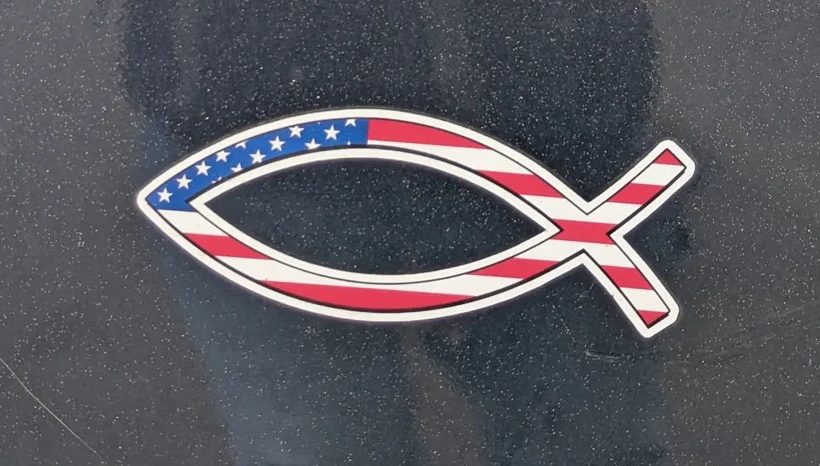
I don’t mean to be sarcastic. Religion and faith are actually, unironically, very very important to me — especially right now. It’s not just the hostilities with Iran. It’s not just the murder of Renée Good. It is a few matters that are deeply personal. I’m not sure how much more I want to say. People are incredibly quick to judge. Even when politics don’t come into it.
Anyway, we were talking about religion. Specifically, the red, white, and blue Jesus fish on that truck — and what it represents.
This statement:
“America is a Christian Nation.”
To some, that is deeply offensive and frightening. To others, it’s just the gosh-darn honest truth.
It sort of depends on who picks up the phone when the pollster calls. That’s the problem with data science these days. There’s no 360° method of getting responses from all people. You can walk up to folks on the street or in malls. You can knock on doors. You can query people on the internet, or by having them fill out a mail-in card. You’ll get different results from any and all of these sources.
What do Americans — and by that, I primarily mean those of us currently residing in the United States, whether or not we were born here, whether or not our first language is English — really believe?
It’s hard to say. I remember seeing this statistic in Newsweek when I was young. Grade-school young. That 95% of Americans believed in God — or some other astoundingly high figure. Not necessarily Jesus, mind you, or the Christian Trinity. Just the idea of one God.
“In God We Trust.”
It’s comforting. It’s even on our currency.
I spent about an hour this morning having a lovely discussion at a house church about a certain scriptural verse:
“No man can serve two masters, or he will hate one and love the other.”
Specifically, this was how Jesus chose to close the Sermon on the Mount. Specifically, Jesus was talking about money.
Another curiously American value.
Along with religious freedom.
Remember, the Establishment Clause — otherwise known as part of the First Amendment — was written to protect the Church from the State, and not the other way around.
Really, anytime you get guns, money, walls, locked doors, and human nature together in a room — this includes a congregation based on faith — you’re going to have trouble.
Church people bicker. Church people make dividing lines:
And remember, church populations include a whole lot of old people. People who may not be totally “with it” mentally, but still write the checks, gossip, and have time on their hands.
The problem is that faith gives people license. They don’t need to explain their actions. They can just say, “because I say so.” Which wouldn’t be so bad, except usually that’s couched as “because God says so.”
News flash: your pastor may be a wonderful or saintly person, but…
I don’t care how learned or inspired they are. They can make mistakes. They can have blind spots. Huge blind spots.
They may not seem like very much, but if you’re backing out of a parking space and only using the rear-view camera, you can run over a child. I’ve seen children get out of parked vehicles suddenly — even in shopping malls. On a Saturday afternoon in March, at Lloyd Center in Portland, Oregon.
The above is what we call a metaphor. But it’s really just an illustration that a blind spot may not be where we think it is. It may not be what is right in front of you. It may not matter what speed you’re traveling, or what the conditions on the road ahead are.
A blind spot can result in a fatality. At any speed.
So — about “Christian nationalism”?
I don’t have much truck with it (sorry, pun intended).
The problem is that it is in direct contradiction to the Great Commission (Matthew 28:19), found at the closing of the Gospel of Matthew, and also Mark. Go and make disciples of all people in every nation. It is an extremely theologically central invocation.
The idea of a religion that is open to all, regardless of nation or tribe, is what defines Christianity — like Islam, but unlike Judaism or Buddhism — as an evangelical religion. That is to say, one that seeks converts. A lot of secular people the world over, and especially close to home, are not comfortable with this aspect of the faith I was raised in.
I’m not an expert. I have never, ever wanted to be a priest or a pastor. Not even a deacon, for heaven’s sake. That’s not my calling. And see especially the comments above about buildings, locks, walls, gates, and human nature. I just went looking for a home church in Oregon last summer because I was severely ill and knew I would need medical transport at a few times in the future. What I found instead was God looming large and unmistakeable. Maybe not enough proof for total certainty. But enough to keep me going through difficult times. No better coping mechanism.
If you were looking for some sort of post about AI, or about literature, or something fun and breezy and lightweight — I’m sorry. I got freaked out by a red, white, and blue Jesus fish on a truck this morning. But all the same, my religion tells me to pray for the person who drove that truck to my neighborhood, and then thankfully drove that truck away — because we have at least a few things in common.
It’s so easy to rush to conclusions. So hard to actually live out the principles of a religion that is grounded in love. Not a lot of other hard and fast rules to it.
Blah blah blah.
I should note that a lot of the culture and jurisprudence of the United States has in fact been shaped by different variants of Christian theology — remembering, of course, that if you go far enough back, the Europeans who ended up in this particular stretch of North America were mostly dissenters and people who were made to feel extraordinarily unwelcome in the countries from which they hailed. (Problem being, of course, people were already living here. The oppressed quickly became the oppressors.)
I think that we are, as a culture, far more secular than we were 20 or 30 years ago, when I was coming up. I think that has a lot to do with the end of the Cold War. Maybe also with the explosion of knowledge fueled by the internet. But most of all, because this has been a good time for a lot of us — here at the apex of our century’s civilization.
Unparalleled prosperity.
People don’t typically look for faith when things are going well. This is paradoxical, because having a faith community of any sort — definitely, for the most part — helps things tend in that direction. As in, “go well.”
A social circle. Pastoral care.
What is frightening and sad is when people get excluded from that circle — and when gossip, prejudice, and snap judgments cause people to step back.
Again, another part of my religion tells me — and others — that we should not judge, lest we be judged.
Unless, of course, you are an actual judge.
Those have included women pretty much since the dawn of recorded history. Pretty cool, eh?
We could in theory have a Supreme Court someday composed of nine women and no men — chosen strictly on merit, of course! What would that look like? No more or less diverse than many governing boards of many gigantic financial entities, including corporations, trusts, and foundations.
But enough with the gender politics. Being female, I have to bring this stuff up occasionally. And incidentally, I am hoping and planning to attend law school.
I guess I want to say that where Christian nationalism becomes not only frightening but truly abominable is when it is simply a cover for white racism.
I know where those people live.
At least some of them.
It’s this majestic, mountainous state known as Idaho.
I’ll be moving there in August, to a quaint campus town called Moscow — so named because of all the wheat farming in the region.
Luck and prayers appreciated.
Imagine two families living side-by-side on the ground floor of a multi-story apartment building. They do not live in Oregon, but in some quaint and more geographically settled area, where gas heat and gas stoves are the norm. It is a sunny Saturday… one of those days when the great outdoors calls out and demands to be explored, with gusto and enthusiasm.

Two couples set out just minutes apart, in two different SUVs. They speed away in opposite directions. One is heading to the mountains. The other is heading to the shore (with perhaps a stop at an outlet mall or a brewpub somewhere along the way). They want to get an early start. They have been working hard all week and are fearful of losing the day. But before much time has elapsed, one person in one car starts to wonder: did she leave the stove on?

This has never happened before, and Ellen is usually very careful about these things. Even OCD. But she had never lived with a gas stove before. Its novelty speaks to her of danger. She remembers turning the gas stove on, to heat up water for instant oatmeal.
But she has no memory of turning the stove off. Why would she?
After much inner debate and turmoil, she brings up her concern. They pull over in the parking lot of a nearby convenience store, so that they can discuss the matter further. After several minutes of intense discussion, it becomes clear that her anxiety is going to ruin the trip unless they head back home.
She convinces her partner to turn around, “just to check.”
Meanwhile, three and a half miles away, the other couple is bickering about the very same possibility. The driver, Craig, is worried because his girlfriend insisted on making them both French toast that very morning before setting out. He is feeling gastric distress from the rich food and secretly wondering if he might be lactose intolerant or allergic to eggs. But he cannot admit that possibility out loud! Instead, he thinks of a convenient way to deflect blame.
He accuses her of leaving the stove on.
She angrily denies the accusation.
He leans across the driver’s seat to confront her. Now he is almost positive he remembers the smell of gas. He tells her so.
“All right, we can go back. But please make it quick!”
“You got it, babe.”
They pull a U-ey though the center of town and barrel homeward, at top speed.
You guessed what’s coming next…
Both vehicles turn abruptly into the narrow parking lot of the apartment building. Both drivers are distracted, and driving a little too fast. They are only a few feet away from their own front doors. They swerve in opposite directions, and in the process collide.
One SUV actually flips, and hurtles through the window of their neighbor’s gas-flooded kitchen.
The result is a fiery conflagration. The entire building goes up in flames. The people in the two vehicles perish. Because of the immense niceness of the day and the complete disappearance of Saturday morning cartoons, no children or pets are harmed.
—
This is the best I can do.
—
It’s possible to draw lots of inferences from this story. Most notably, don’t speed and don’t necessarily leave the womenfolk to do all the cooking.
It’s also not an indictment of natural gas from a safety standpoint. Serious fires can be caused by something as simple as an electrical cord left too close to a burner. Deaths can be caused by generators1 used indoors or garages. As a foodie, there is no substitute! I miss my JennAir from Charlotte, North Carolina — as well as the ancient and nameless stove that served me well for eight idyllic years in rural Massachusetts.
But yes, there is a lesson to be learned here. I’ll get to it shortly.
In this hypothetical thought experiment, the gas main would not have been damaged if somebody had not left their stove on, releasing a significant amount of combustible gas vapor into the air.
But which stove? Which kitchen?
Here is where we encounter several possibilities.
In other words, Ellen (the oatmeal eater) simply forgot whether she left the gas on in her apartment. She had a memory lapse. She was coming back to check on the situation. Had she and her partner not collided with the other vehicle, the situation would have been contained and everything would have been fine.
Craig (the guy who ate the French toast) convinced himself that he had smelled gas. This might have been an example of confabulation (in other words, manufacturing a false memory). This urgent but totally rational fear led him and his hapless girlfriend to be in the wrong place at the wrong time.
But what if Craig’s memory was the true one? What if Ellen was imagining things?
Same outcome.
Change up the positions and the velocities of the two vehicles, or change which couple had rented which apartment, and it wouldn’t matter.
Where am I going with all this?
We all know about fake news and fake memories.
We recognize that many people lie out of habit and even forget what the truth is. But that’s not all. We assume that others can be misled, then conveniently adopt the narratives that fit with our own experience and beliefs. That’s old news.
Objective reality? What’s that? Do you actually believe there was a moon landing?
We know the power of the crowd — the influence of suggestion, of propaganda, of mass hysteria.
What we forget is that memories and perceptions change of their own accord, independent of any direct causal event. When two or more sets of memories interact — particularly when these memories are different or opposing, and when a fear factor is present — the potential for conflict is high.
The scientific method yearns for an objective truth. A single, definitive answer. We want our heroes and villains. We want to know what actually happened.
Come on, storyteller…
Who is at fault? Who really left the gas on?
To the insurance company determining fault and cause, the answer matters. They are the money people. The bag holders. They need forensic evidence in order to proceed with processing the property owners’ claim. To everyone else, we just have a senseless tragedy. Who was at fault is not important. Both sides, or neither. Mistakes compounding mistakes.
The moralists just throw up their hands and walk away. Senseless violence. Hasty actions with terrible consequences. They surround us.
The optimist looks for a lesson from the story and remembers that this is a work of fiction and not an item from the local newspaper. (Although these days you never know…)
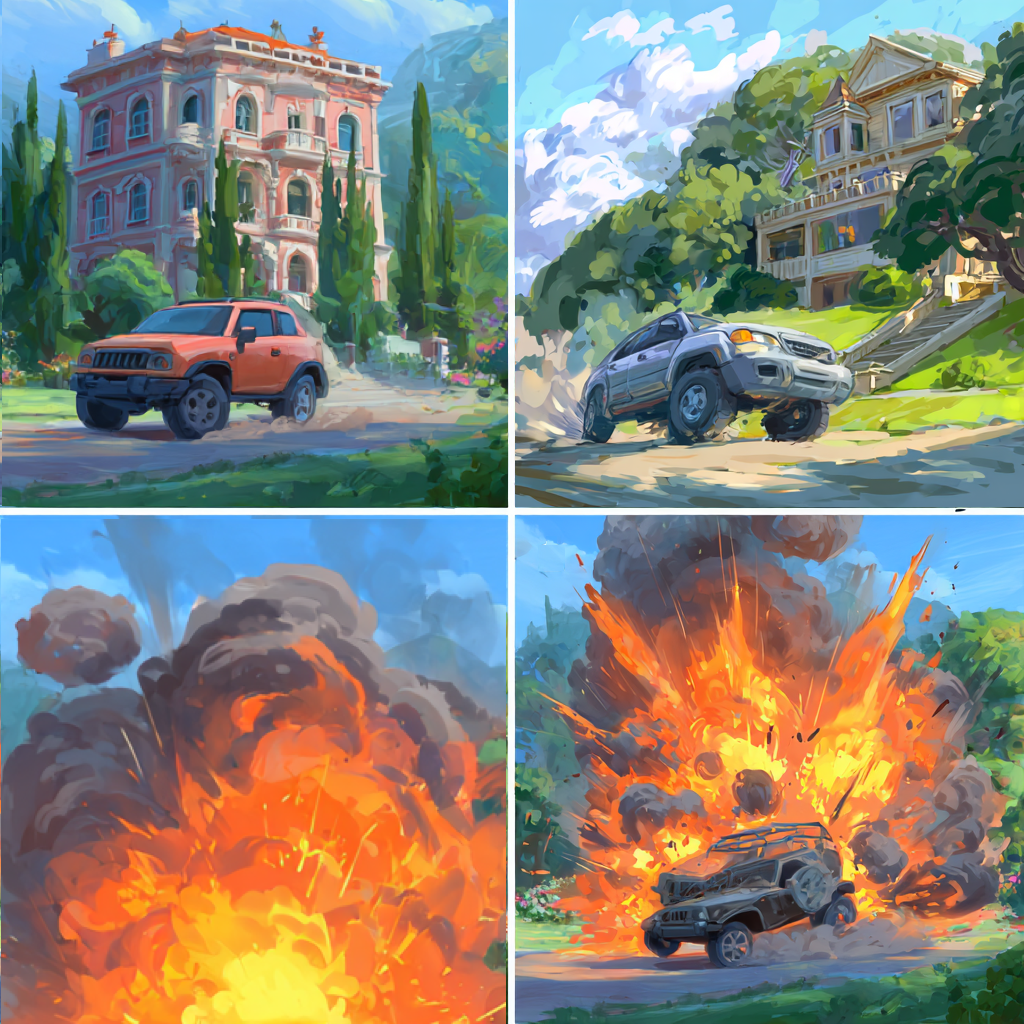
I included two symbols, placed very intentionally.
Here are the cheat codes:
The first symbol is the natural gas line. In this example, it represents the power of the state. Specifically, police and military power. But you could also expand this metaphor to include licensed possession of firearms — or medical and teaching licenses. Much like public utilities, these are systems that taxpayers fund and often take for granted. They lawfully grant individuals the authority to make life and death decisions. In a democracy — at least in theory — we as citizens set the rules.
The second symbol is the explosion that engulfs the building. And no, I didn’t place it there just for effect. Those flames represent violence — lives lost, and the grief of loved ones. But also risks to the first responders who arrive at the scene. As well as environmental damage and financial disaster (we will assume not all individuals in the building had renters’ insurance).
There are so many kinds of evil lurking in the world…
What I am trying to get at here is preventable evil.
This is the type of harm that occurs due to ignorance, stupidity, and sheer bad luck. It is inescapable. But with the right outlook, we can cut down on the number of incidents.
It really is still about how we treat our neighbors. What assumptions we make, and how quickly we move to act on them.
None of us are infallible. Neither the present, the future, or the past are totally within our control.
Liberating ourselves from fear doesn’t free us from the consequences of other people’s fear and stupidity. In the short term, it can make us targets. Cultivating an attitude of patience and generosity, of awareness and forgiveness, might be a starting place. It might actually create network effects.
1 Never use an electrical generator indoors. (Source: https://www.cpsc.gov/Newsroom/News-Releases/2007/Know-Carbon-Monoxide-Dangers-Before-the-Power-Goes-Out)